
The Engineering Logic of Profile Selection: IBR vs. Corrugated Roofing in Gauteng
In the South African “sinkplaat” market, the choice between Inverted Box Rib (IBR) and the traditional Corrugated (IBR vs corrugated roofing) profile is a decision rooted in structural engineering, fluid dynamics, and environmental risk management. For the budget-conscious developer in Gauteng, choosing the wrong profile can lead to hidden structural costs that far outweigh the initial savings on material. This guide provides a deep technical analysis of how profile geometry dictates the performance and cost-efficiency of steel roofing in the unique Highveld climate.
1. The Physics of Strength: Inverted Box Rib (IBR 686)
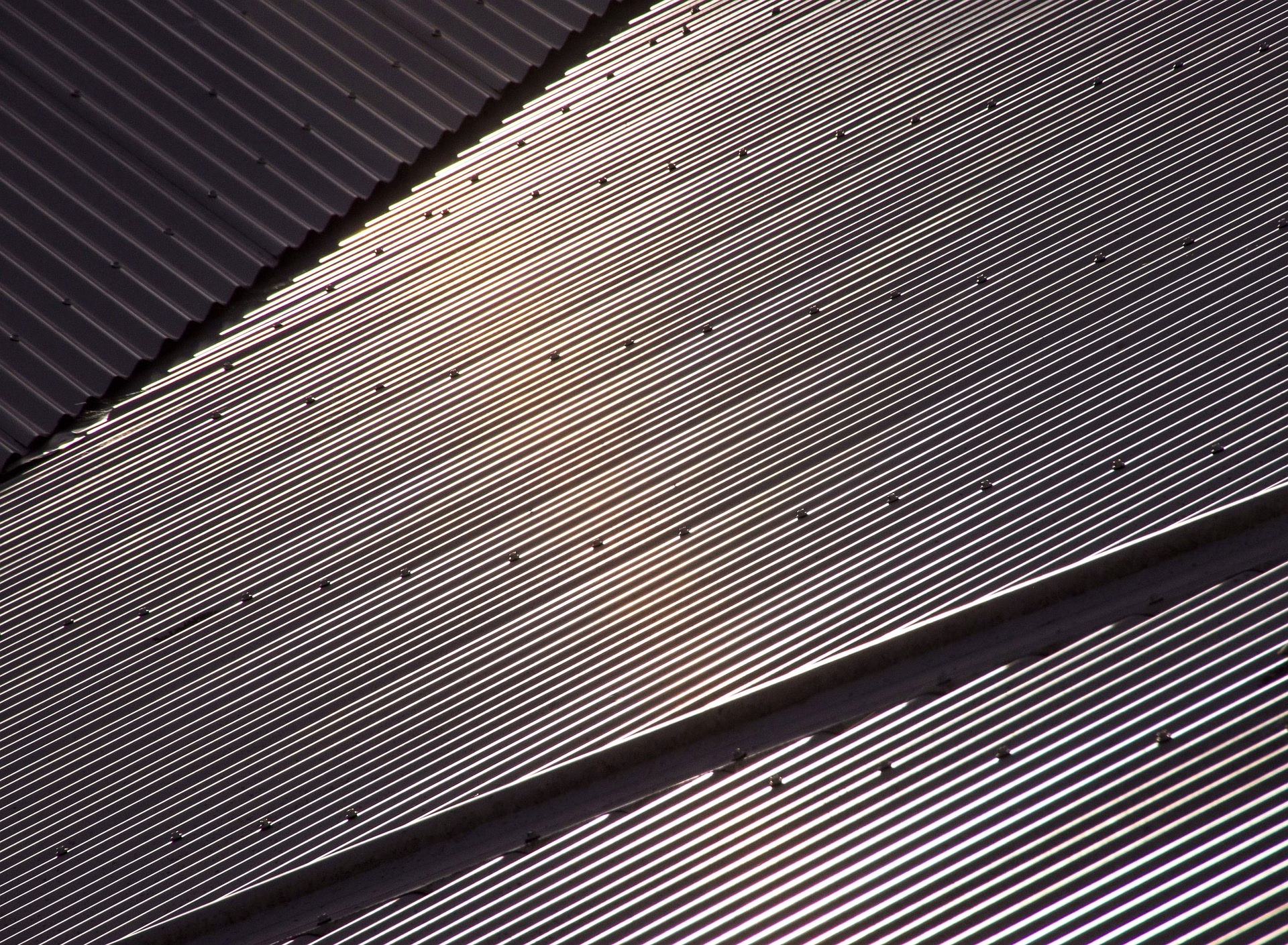
IBR is a square-fluted profile with a nett cover width of 686 mm, defined by its five trapezoidal ribs spaced at 171.5 mm centers. The name “Inverted Box Rib” has become a household name in the South African building industry because it represents a leap forward in the strength-to-weight ratio of profiled sheeting.
1.1 Rib Geometry and Structural Rigidity
The standard rib height for IBR is 37 mm. This depth provides exceptional structural rigidity. In engineering terms, the deep ribs act as mini-girders along the length of the sheet. By concentrating the material into these high-standing trapezoidal forms, the profile’s Moment of Inertia (I) is significantly increased compared to a flat or wavy sheet of the same gauge.
The trapezoidal flute design offers the optimum balance between material mass and load-span characteristics. This geometric stiffness allows IBR to resist both positive pressure (downward loads from maintenance traffic or hail accumulation) and negative pressure (wind uplift) more effectively than sinusoidal profiles.
1.2 Drainage Dynamics and Low-Pitch Performance
The deep, broad flute design of IBR offers excellent drainage characteristics, which is critical for the intense thunderstorms characteristic of Gauteng. Because of its high water-carrying capacity, IBR is suitable for nearly flat roofs. According to manufacturer and SANS standards, IBR can be used at a minimum pitch of 5° for sheet lengths up to 20 meters. If the roof run exceeds 30 meters, the recommended minimum pitch is increased to 7.5 ° to prevent water accumulation.
For industrial applications where large volumes of water must be shed rapidly, the trough-depth of IBR ensures that the side-laps remain above the water line, reducing the risk of “back-wash” leaks during Highveld cloudbursts.
2. The Enduring Versatility: Corrugated (S-Rib 762)
The corrugated profile, often called the “S-Rib,” is the traditional and familiar profile that has defined South African architecture for over 170 years. It features 10.5 sinusoidal waves giving a nett cover width of 762 mm.

2.1 Rib Geometry and Structural “Softness”
With a rib height of only 17.5 mm, corrugated sheeting is structurally “soft” compared to IBR. The sinusoidal wave pattern, while visually appealing and easy to handle, lacks the geometric stiffness required for long spans. Because the waves are shallow, the sheet provides less resistance to bending, meaning it requires more frequent support members (purlins or latjies) to maintain its integrity under load.
2.2 Pitch and Drainage Limitations
Because the waves are shallow, water can easily over-top the side-laps during heavy rain. This leads to specific pitch requirements that are more restrictive than those for IBR. For corrugated sheeting, the recommended minimum pitch is $10^\circ$ for slopes less than 15.8 meters. For slopes exceeding 15.8 meters, the minimum pitch must be at least $12.5^\circ$ to prevent leaks caused by capillary action or water backing up the slope.

3. Span Comparisons and Structural Cost Optimization
A “budget” roof is only cheap if the supporting structure—the trusses and purlins—is optimized. The profile’s spanning capability directly dictates the number of “latjies” required for the project.
3.1 Maximum Purlin Spacing Guidelines
The following table illustrates the typical maximum support spacing for IBR and Corrugated profiles across various material gauges (thicknesses).
| Material Gauge (mm) | IBR Max Purlin Span (m) | Corrugated Max Purlin Span (m) |
| 0.40 (Light Duty) |
1.2 – 1.5
|
0.8 – 1.0
|
| 0.50 (Standard) |
1.5 – 1.8
|
1.0 – 1.2
|
| 0.58 (Heavy Duty) |
1.8 – 2.1
|
1.2 – 1.4
|
3.2 The Budget Paradox
While a corrugated sheet is often slightly cheaper per linear meter than an IBR sheet, the structural requirements for corrugated roofing are higher. For a standard 150 m2 Gauteng home, using IBR could reduce the required number of purlins by up to 30%. This reduction in timber or steel framework often compensates for IBR’s higher material price, resulting in a lower total project cost.
Furthermore, IBR’s wider span allows for more flexibility in truss placement, which can lead to further savings in the overall roof structure design.
4. The Gauteng “Hail Factor” and Impact Resistance
Gauteng experiences some of the most severe hailstorms in South Africa. Research into hail impact on steel roofing shows that profile geometry plays a vital role in how well a sheet resists permanent deformation (denting).

4.1 Dent Defense by Profile
IBR’s beefy 37 mm ribs provide what industry experts call “muscle” against hail. The deeper channels help spread the energy of the impact, and the high ribs are more difficult to crush than the shallow waves of a corrugated sheet.
Conversely, corrugated sheeting is notorious for “golf-ball dimples” after a storm. The shallow 17.5 mm waves provide less support to the flat areas between the waves, making it more prone to bruising. This is particularly true for older or thin-gauge (below 0.40 mm) installations.
4.2 Material Hardness and Yield Strength
The impact resistance is not just a function of shape but also of the steel grade used. High-yield materials like ISQ550 or G550 are often used for budget-range thin sheets to provide a higher resistance to denting.
-
ISQ300/ISQ230: Commercial quality with lower yield stress, typically used in thicker gauges (0.58 mm+).
-
ISQ550/G550: High-tensile steel, which allows for thinner (0.40–0.50 mm) sheets that remain rigid enough to withstand maintenance traffic and hail.
5. Water Carrying Capacity and Manning’s Formula
For engineers and contractors in the Vaal Triangle and Johannesburg industrial nodes, calculating the water-shedding ability of a roof is vital for preventing systemic failure.
The discharge capacity of a roof profile can be estimated using a variation of Manning’s Formula:
Where:
-
Q is the discharge (flow rate).
-
n is the coefficient of roughness (typically 0.012 to 0.016 for galvanized steel).
-
A is the cross-sectional area of the flute.
-
R is the hydraulic radius.
-
S is the slope (pitch) of the roof.
Because IBR flutes have a significantly larger cross-sectional area (A) and a deeper trough (41 \text{ mm}$ for some profiles like Craft-Lock), they can carry much higher volumes of water before reaching the “over-top” point at the side-laps. Corrugated sheets have a very low A per wave, meaning that during a Gauteng cloudburst, the water level in the sinusoidal trough can quickly exceed the 17.5 mm rib height, leading to leaks into the building’s interior.
6. Widespan: The “Budget-Plus” Alternative
In recent years, the Gauteng market has seen the rise of Widespan sheeting as a middle-ground solution. Widespan offers an economical alternative to the deeper box-rib profiles without losing the modern square-fluted aesthetic.
-
Effective Cover: 762 mm (identical to corrugated).
-
Rib Height: Typically 28 mm to 29 mm.
-
Pitch: Recommended at 7.5° for slopes up to 30 meters.
Widespan provides 10% more coverage than IBR per sheet, which speeds up installation time and reduces the number of side-laps. However, because its ribs are shallower than IBR, its spanning capability falls between IBR and corrugated, requiring purlin centers around 1.2–1.5m for standard 0.50mm material.
7. Installation Best Practices and SANS Compliance
Even the best-engineered profile will fail if the installation does not comply with the National Building Regulations (SANS 10400-Part L).
7.1 Fixing Procedures: Crest vs. Valley
In South Africa, the professional standard is to fix through the crests of the ribs when used for roofing.
-
IBR: Fasten through the crests of alternate flutes to the purlins.
-
Corrugated: Fasten through the crests of alternate waves.
A common DIY mistake is to fasten through the valley (the bottom) of the wave. While this seems more secure, it places the fastener in the direct flow of water, leading to rapid corrosion and high-volume leaks if the washer degrades. For wall cladding, however, fixing in the web (the flat area) is the recommended procedure for aesthetic and wind-uplift reasons.
7.2 Fastener and Washer Specifications
The choice of fastener must match the expected lifespan of the roof sheeting. In Gauteng’s industrial zones, the use of Class 3 or Class 4 fasteners (complying with SANS 1273) is essential.
-
Timber Purlins: Require 65 mm (Corrugated) to 90 mm (IBR) Tek screws to ensure at least 35–40 mm of embedment into the wood.
-
EPDM Washers: All fasteners must incorporate 25 mm or 26 mm diameter EPDM bonded washers. These provide a watertight seal and act as a thermal buffer during the Highveld’s extreme daily temperature fluctuations.

7.3 End Laps and Sealing
For low-pitch roofs ($<7.5^\circ$), it is imperative to seal the end laps with a high-quality bitumen sealing strip or butyl tape. Minimum end laps vary by pitch:
-
Pitch > 15°: 150 mm minimum end lap.
-
Pitch < 15°: 250 mm minimum end lap, plus mandatory sealing.
8. Avoiding the “Sinkplaat Scam” in the Budget Market
For property owners looking to maximize their budget, the market can be a minefield of low-quality materials and deceptive specifications.
8.1 The Gauge Deception
Some suppliers provide “thin edges” to deceive buyers who test thickness at the sheet’s edge. Always request to check the metal thickness in the middle of the sheet with a micrometer. Genuine 0.47 mm TCT (Total Coated Thickness) or 0.50 mm should be verified against the manufacturer’s data sheet.
8.2 The “Fake Chromadek” Issue
Chromadek® is a registered trademark of ArcelorMittal South Africa. Many distributors sell low-grade painted sheets and call them “Chromadek.” These sheets often peel or fade within 3–5 years because they lack the specific oven-cured paint system and Z200/Z275 galvanized substrate required for the African sun. Real Chromadek is labeled on the back of the sheet.
9. Conclusion: The Professional Recommendation for Gauteng
Choosing between IBR and Corrugated is a matter of prioritizing structure or aesthetic nostalgia.
-
Choose IBR (9/10 Scorecard): If your roof has a pitch below $10^\circ$, if you are in a hail-prone area, or if you want to minimize structural timber costs by using wider purlin spans. IBR remains the superior all-rounder for Gauteng conditions.
-
Choose Widespan (8/10 Scorecard): For large factories or farm sheds where installation speed and reduced side-laps are the primary cost-saving drivers.
-
Choose Corrugated (6/10 Scorecard): For smaller, budget-led residential projects, rural outbuildings, or structures where a “Boere-modern” or rustic aesthetic is paramount. Ensure your roof pitch is steep (at least $12.5^\circ$) to compensate for its drainage limitations.
Regardless of the profile, the ultimate value of a budget steel roof in Gauteng is determined by its compliance with SANS 10400-L and the acquisition of a valid A19 Certificate of Compliance upon completion. This legal document ensures that the engineering logic of your profile selection has been correctly translated into a safe, durable, and insurable structure.
Summary Comparison Table for Gauteng Specification
| Metric | IBR 686 | Corrugated 762 | Widespan 762 |
| Min. Pitch |
5°
|
10°
|
7.5°
|
| Max Span (0.5mm) |
1.5 – 1.8 m
|
1.0 – 1.2 m
|
1.2 – 1.5 m
|
| Hail Resistance |
Excellent (9/10)
|
Fair (6/10)
|
Good (8/10)
|
| Effective Cover |
686 mm
|
762 mm
|
762 mm
|
| Best Use | Commercial/Industrial | Residential/Sheds | Large Warehouse |
Return to The Ultimate Guide to Budget Steel Roofing in Gauteng